Blog

  • Redacted: What the Files Don’t Say

    Redacted: What the Files Don’t Say

    Governments have been studying UFOs for more than 75 years. That is not a theory. It is in the public record. The question is not whether they looked, but what they found and what they kept.

    Roswell, 1947

    In July 1947, the Roswell Army Air Field in New Mexico issued a press release saying it had recovered a “flying disc”. Within a day the story changed: it was a weather balloon. Decades later, in the 1990s, the U.S. Air Force released reports saying the debris came from Project Mogul, a classified program using high-altitude balloons to listen for Soviet nuclear tests, and that later stories of “bodies” were most likely confused memories of crash-test dummies dropped in the 1950s.

    Three different explanations for the same event. Each one was official at the time.

    Project Blue Book

    From 1952 to 1969, the U.S. Air Force ran Project Blue Book to investigate UFO reports. It collected 12,618 of them. When it closed, 701 were still listed as unidentified. The Air Force concluded that none posed a threat and none showed evidence of technology beyond our own.

    The gaps

    • Why did it take decades to reveal the true purpose of the Roswell debris?
    • Why were 701 Blue Book cases closed without an explanation?
    • Why do modern reports still arrive with large parts blacked out?

    There are ordinary answers: national security, embarrassment, bureaucracy. Secret aircraft programs are real, and they need cover stories. But every redaction leaves a gap, and gaps get filled with questions.

    We are not asking you to believe. We are asking you to keep asking.

    If you have documents, photos or first-hand knowledge, we want to hear from you. Contact us.
  • The Visitors: How the “Grey” Became the Face of the Unknown

    The Visitors: How the “Grey” Became the Face of the Unknown

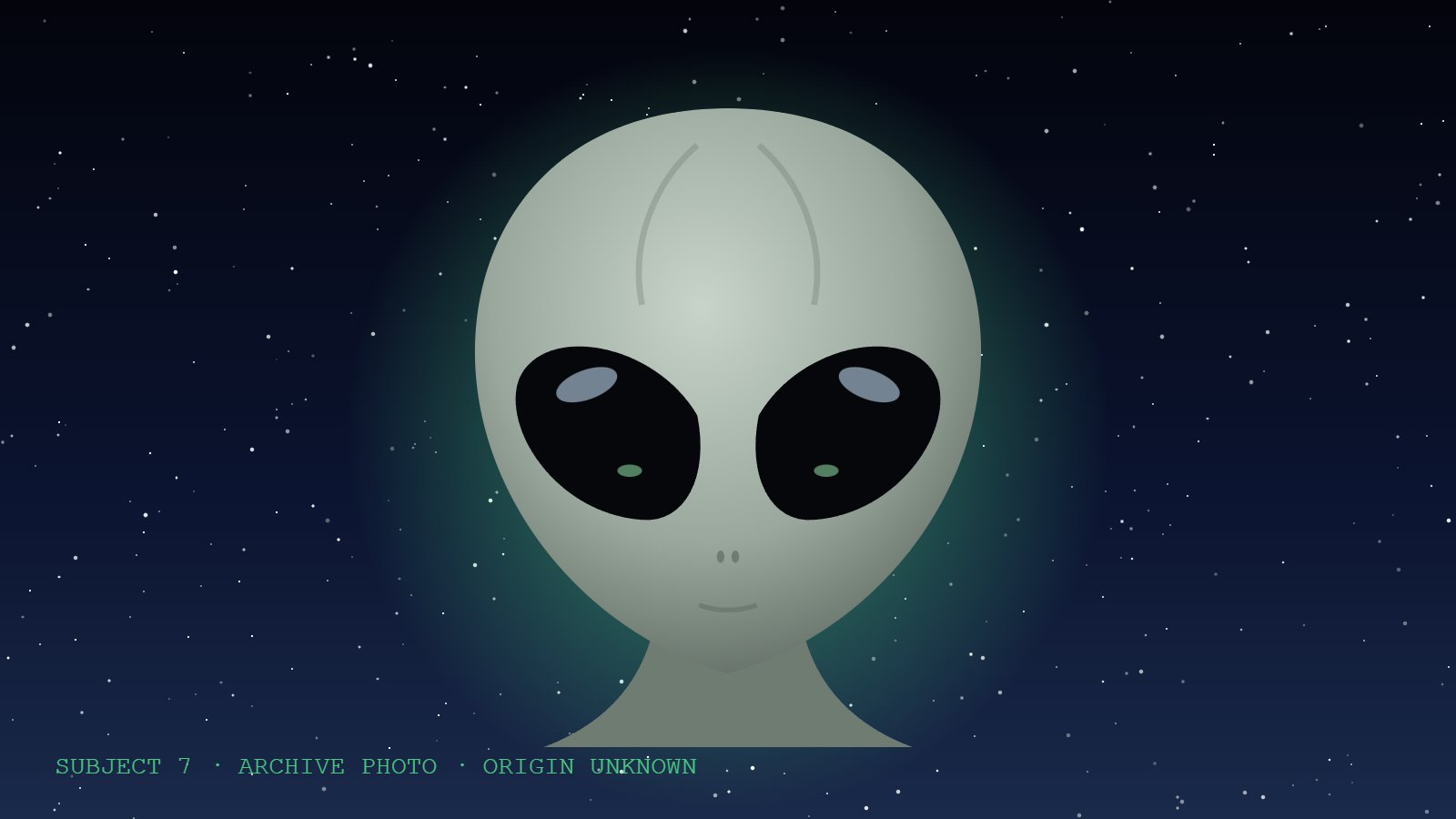
    Ask anyone to draw an alien and you will probably get the same figure: a smooth, oversized head, huge black almond-shaped eyes, a thin body and grey skin. Where did that picture come from, and why is it so consistent?

    The first famous encounter

    One of the earliest widely reported abduction accounts comes from Betty and Barney Hill, a couple from New Hampshire. In September 1961 they were driving home at night when, they said, a strange craft followed their car. They arrived home hours later than expected with gaps in their memory. Under hypnosis they later described being taken aboard and examined by short beings with large eyes.

    The story became a book and a TV film, and the image of the small, large-eyed visitor spread around the world.

    Culture or contact?

    Skeptics argue that the Grey is a product of culture: once the image appeared in books, films and magazine covers, people reported what they had already seen. Believers ask a harder question: why would independent witnesses in different countries describe the same details, like the absence of a nose and ears, or the feeling of paralysis?

    • Missing time: hours that cannot be accounted for
    • Paralysis: being unable to move or call out
    • Bright light: often the first and last thing remembered
    • Calm, wordless communication that seems to happen “in the head”

    Researchers note that several of these features overlap with sleep paralysis, which can cause vivid visions and a strong sense of a presence in the room. That explanation fits many cases. Whether it fits all of them is another question.

    Has something like this happened to you or someone you know? Your account is safe with us. Get in touch.

  • Lights Over the Forest: The Sightings That Will Not Go Away

    Lights Over the Forest: The Sightings That Will Not Go Away

    For decades, seeing a UFO was a punchline. Then the people reporting them started to include trained military pilots with radar data to back them up.

    The official word: “unidentified”

    In June 2021, the U.S. Office of the Director of National Intelligence published a preliminary assessment of what it now calls unidentified aerial phenomena, or UAP. It reviewed 144 reports from U.S. government sources, mostly military aviators. It could explain exactly one of them.

    Some of the objects were described as staying still in high winds, moving against the wind, or accelerating in ways that are hard to match with known aircraft. The report did not say they were alien. It also did not say they were not.

    A new office for an old mystery

    In 2022 the Pentagon set up the All-domain Anomaly Resolution Office (AARO) to collect and investigate these reports. Thousands more have come in since. AARO says most turn out to be balloons, drones, birds or clutter, and in 2024 it reported finding no evidence of extraterrestrial technology.

    Supporters of disclosure point out that an office whose job is to resolve anomalies has every reason to resolve them. Skeptics point out that “unresolved” usually just means “not enough data”. Both sides agree on one thing: some cases remain open.

    What the sightings have in common

    • Silent, bright lights that hover and then leave at high speed
    • Objects with no visible wings, engines or exhaust
    • Sightings near military bases, nuclear sites and remote forests
    • Electronics, car engines or radios that cut out during the event

    Have you seen lights you could not explain? Write down the date, time, place and direction, and send us your report.

  • Are We Alone? The Numbers Say Probably Not

    Are We Alone? The Numbers Say Probably Not

    Start with the numbers, because the numbers are not secret. Our galaxy holds somewhere between 100 and 400 billion stars. Planet-hunting telescopes have shown that most of those stars have planets, and a meaningful share of sun-like stars have a rocky, roughly Earth-sized world in the zone where liquid water could exist.

    Do the multiplication and you get billions of potentially habitable planets in the Milky Way alone. Then remember there are perhaps two trillion galaxies in the observable universe.

    The equation that started it all

    In 1961, astronomer Frank Drake wrote down a simple equation to estimate how many civilizations in our galaxy might be able to communicate with us. It multiplies the rate of star formation by the fraction of stars with planets, the fraction of those planets that could support life, the fraction where life actually appears, becomes intelligent, builds technology, and how long such a civilization lasts.

    Nobody knows most of those values. But plug in even cautious guesses and the answer rarely comes out as one. It usually comes out as many.

    So where is everybody?

    That question is usually credited to physicist Enrico Fermi, who is said to have asked it over lunch at Los Alamos in 1950. If the galaxy should be full of life, and some of it had a head start of millions of years, why is there no sign of it? This is the Fermi paradox.

    Mainstream science offers explanations:

    • The Great Filter: something stops almost every civilization before it reaches the stars. It might be behind us, or ahead of us.
    • Distance: the galaxy is huge, signals fade, and we have only been listening for a few decades.
    • Rare Earth: complex life may need a long list of lucky accidents.

    And then there is the explanation this site exists to ask about: what if they are not missing at all? What if the silence is not an absence, but a policy?

    Absence of evidence is not evidence of absence, especially when someone controls the evidence.

    We are not claiming to have the answer. We are claiming the question deserves better than a shrug. Keep reading, and tell us what you have seen.